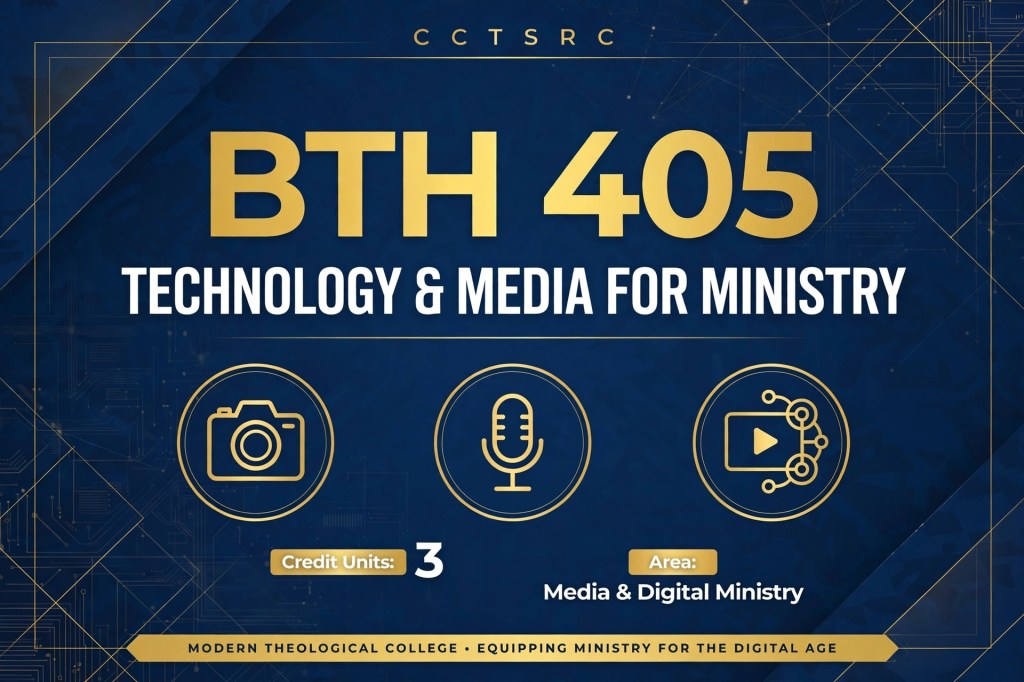
Level: Year Two – Second Semester
Credit Units: 3
Area of Specialization: Media & Digital Ministry
Course Duration: 15 Weeks (9 Core Modules)
COURSE DESCRIPTION
This course explores the intersection of theology, technology, and media. In an increasingly digital world, the church must understand how to steward technological tools for the advancement of the Kingdom of God. This course provides both a theological framework for understanding technology and practical skills for utilizing digital media, audio-visual systems, social platforms, and church management software. Students will learn to bridge the gap between the timeless gospel and contemporary digital culture, ensuring that technology serves the mission of the church rather than mastering it.
COURSE OBJECTIVES
By the end of this course, students will be able to:
- Articulate a biblical theology of technology and media.
- Utilize Church Management Software (ChMS) for effective administration and member care.
- Understand the fundamentals of audio-visual production for live church services.
- Develop and implement a comprehensive social media strategy for ministry.
- Create basic digital content (graphics, videos, podcasts) for evangelism and discipleship.
- Navigate the ethical, security, and spiritual challenges of digital ministry.
MODULE 1: Theology of Technology
Introduction
Before picking up a camera or opening a social media app, the minister must understand the theological implications of technology. Technology is not neutral; it shapes how we think, relate, and worship. This module explores technology as a gift from God, a tool for the Great Commission, and a potential idol.
Topic 1: Defining Technology and Media
- What is technology? (From the Greek techne – art/craft, and logos – word/study).
- The difference between tools (devices) and media (carriers of information).
- The progression of human communication: Oral -> Written -> Print -> Broadcast -> Digital.
Topic 2: A Biblical Framework for Technology
- Creation Mandate: God created humans with the capacity to create (Genesis 1:28). Technology is an extension of our God-given creativity.
- The Fall: Technology is affected by sin (e.g., the Tower of Babel – technology used for human glory rather than God’s).
- Redemption: Technology can be redeemed and used for worship, evangelism, and healing.
- The Incarnation as Ultimate Communication: God communicated His love through the Word becoming flesh (John 1:14). Digital ministry must point to embodied community.
Topic 3: The Ethics of Digital Communication
- Truth vs. Clickbait: Are we misrepresenting the gospel to gain views?
- The Attention Economy: How media platforms are designed to be addictive and how Christian ministers should steward attention.
- The Digital Divide: How technology creates inequality and the church’s responsibility to the poor and elderly.
Module 1 Assignment: Write a 1,000-word essay reflecting on the statement: “Technology is a wonderful servant but a terrible master.” Apply this to modern church ministry.
MODULE 2: Digital Church Management
Introduction
A growing church is a complex organization. Managing members, finances, attendance, and volunteer schedules requires more than a paper ledger. Church Management Software (ChMS) is the administrative backbone of the modern digital church.
Topic 1: The Role of Data in the Church
- Moving from “numbers” to “names.” Data is not just statistics; it is a representation of human souls.
- How to use data to identify needs (e.g., tracking absenteeism to initiate pastoral care).
- Privacy and GDPR/Data Protection laws: The church’s ethical obligation to protect member information.
Topic 2: Core Features of ChMS
- Member Database: Profiles, family linking, and milestone tracking (birthdays, anniversaries, baptisms).
- Financial Management: Online giving portals, tithe tracking, and automated giving statements.
- Event and Facility Management: Booking rooms, tracking event registrations.
- Volunteer Scheduling: Rostering for ushers, media team, and children’s ministry.
Topic 3: Popular Platforms & Implementation
- Overview of platforms: Planning Center, Tithe.ly, Church Community Builder, Breeze.
- How to migrate from analog to digital without losing the relational touch.
- Training staff and volunteers to use the software.
Module 2 Assignment: Create a mock “Membership Profile” workflow. Outline the steps from a first-time visitor filling out a digital connect card to being added to the ChMS database and assigned a follow-up leader.
MODULE 3: Audio-Visual Production
Introduction
The worship service is a physical gathering, but it is also a media event. From the sound system to the screens, technology mediates the experience. This module covers the technical basics of running a Sunday service.
Topic 1: Live Sound Engineering for the Church
- Understanding the signal chain: Microphones -> Mixing Console -> Amplifiers -> Speakers.
- The difference between Front of House (FOH) mixing and Monitor mixing.
- Basic EQ (Equalization): How to make vocals sound clear and eliminate feedback.
- Common pitfall: Too loud vs. Too quiet. Creating an immersive yet comfortable audio environment.
Topic 2: Visual Presentation and Lighting
- Projection: Choosing the right software (ProPresenter, EasyWorship). Screen formatting, lyric safety areas, and font legibility.
- Lighting Basics: The role of lighting in creating atmosphere and directing focus. Front lighting vs. stage wash.
- The Visual Sanctuary: How screens and lights can either distract from or enhance the worship experience.
Topic 3: Live Streaming Essentials
- The “Online Congregation”: Treating the livestream viewer as a real member, not an afterthought.
- Cameras: Angles, framing, and switching.
- The Technical Setup: Encoders (OBS Studio), internet bandwidth requirements, and multi-platform streaming (Facebook, YouTube, Church Website).
- The Role of the Online Host: Chat moderation, welcoming online viewers, and digital pastoral care.
Module 3 Assignment: Design a Sunday morning media team roster. Include roles for: Sound Engineer, Slides Operator, Livestream Director, Camera Operator, and Online Chat Host. Write a brief job description for each role.
MODULE 4: Graphic Design & Church Branding
Introduction
The church’s visual identity communicates its values. Poorly designed graphics can communicate disorganization, while excellence in design communicates the worthiness of the gospel. This module equips students with basic design skills using accessible tools.
Topic 1: The Power of Visual Communication
- How the brain processes images faster than text.
- Branding: What is it? (It’s more than a logo). It is the church’s voice, tone, and visual identity.
- The mission statement translated into visual elements (color palettes, typography).
Topic 2: Fundamentals of Graphic Design
- The Four Principles: Contrast, Repetition, Alignment, and Proximity (CRAP).
- Typography: Choosing readable and appropriate fonts. The danger of “Comic Sans” in a formal setting.
- Color Theory: How colors evoke emotion. Using the church’s brand colors consistently.
Topic 3: Tools and Application
- Canva for Ministry: A hands-on look at the world’s most accessible design tool. Using templates, resizing for social media, and brand kits.
- Sermon Series Graphics: Creating a cohesive look for a 4-week sermon series.
- Print vs. Digital: Designing for a poster vs. designing for an Instagram story (aspect ratios matter).
Module 4 Assignment: Create a complete “Sermon Series Visual Kit” using Canva. Submit a main title graphic, an Instagram post, a square social media graphic, and a vertical story graphic. Theme: “Living in the Light” (1 John 1:5-7).
MODULE 5: Social Media Strategy for Ministry
Introduction
Social media is the modern Areopagus (Acts 17). It is where people gather, debate, and seek answers. However, simply posting a Bible verse daily is not a strategy. This module teaches how to be intentional with digital platforms.
Topic 1: The Philosophy of Social Media Ministry
- The Digital Megaphone: Reaching the lost vs. edifying the found.
- The Digital Handshake: Social media is the new front door of the church.
- Consistency over Perfection: Why waiting for the perfect video often results in doing nothing.
Topic 2: Platform-Specific Strategies
- Facebook: The community hub. Great for events, groups, and live streaming to older demographics.
- Instagram: The visual storytelling platform. Reels, stories, and behind-the-scenes glimpses into church life.
- TikTok/YouTube Shorts: The attention economy. Creating short, punchy, biblically sound content that can go viral. The power of “Edutainment.”
- X (formerly Twitter): Real-time engagement, theological discussion, and news.
Topic 3: Content Creation & Scheduling
- The Content Pillars: 1. Gospel/Inspiration, 2. Community/Behind-the-scenes, 3. Vision/Announcements, 4. Education/Teaching.
- Scheduling Tools: Using tools like Buffer or Meta Business Suite to plan a week’s content in advance.
- Engagement: The importance of responding to comments, handling trolls gracefully, and praying for people who respond to posts.
Module 5 Assignment: Develop a 30-day Social Media Content Calendar for a church youth group. Include specific post ideas, the platform for each post, and the time of day it will be posted.
MODULE 6: Web Development and Content Creation
Introduction
The church website is the 24/7 digital campus. It is the place where people find service times, listen to sermons, and give. This module explores the basics of managing a church web presence and creating long-form digital content.
Topic 1: The Church Website
- The purpose of the website: Information, connection, and discipleship.
- First Impressions: Design, mobile responsiveness, and navigation. (Most users are on mobile).
- The “Next Steps” Button: How to guide a visitor to plan a visit, watch a sermon, or request prayer.
- Platforms: WordPress, Squarespace, or church-specific builders (like Subsplash or Tithe.ly Sites).
Topic 2: Podcasting and Audio Ministry
- Why every church should have a podcast (sermon audio, devotional thoughts, interviews).
- Basic equipment: A dynamic microphone (e.g., Shure SM58), an audio interface, and a computer.
- Editing software: Audacity (free), Descript.
- Hosting platforms: Spotify for Podcasters, Apple Podcasts.
Topic 3: Blogging and Written Content
- The power of the written word in a visual age.
- Devotional writing for the web: Short paragraphs, subheadings, and clear calls to action.
- Search Engine Optimization (SEO) basics for churches: Choosing titles and tags that help people find your content.
Module 6 Assignment: Write a 500-word blog post on “Why Community Matters.” Then, outline a 5-step plan for how your church website will guide a new visitor from “finding the site” to “attending a service.”
MODULE 7: Video Editing and Storytelling
Introduction
Video is the dominant medium of our time. It combines audio, visual, and narrative into a powerful emotional tool. The church has the greatest story ever told; we must learn to tell it well in a video format.
Topic 1: The Art of Visual Storytelling
- The three-act structure: Setup (Problem), Conflict (Search/Struggle), Resolution (The Gospel/Testimony).
- The power of the Testimony Video: How to conduct an interview that brings out the redemptive arc of a person’s life.
- The Vision Video: Casting a vision for a new building, ministry, or campaign.
Topic 2: Practical Video Editing
- Editing Software: CapCut, Adobe Premiere Rush, DaVinci Resolve (Free).
- The Timeline: Cutting for pacing, J-cuts, L-cuts, and B-roll.
- Audio in Video: The rule of thumb: “Bad video with good audio is tolerable; good video with bad audio is unwatchable.”
- Color Grading: Making your footage look cinematic and consistent.
Topic 3: Short-Form Video for Evangelism
- Creating “Reels” or “Shorts” from a 40-minute sermon.
- Adding captions (most people watch video on mute).
- The hook: How to grab attention in the first 3 seconds.
Module 7 Assignment: Using a smartphone, record a 2-minute interview with a friend or family member about a time they experienced God’s provision. Edit the footage, adding B-roll (supplementary footage), background music, and captions, and submit the final video file.
MODULE 8: Cybersecurity and Digital Ethics
Introduction
Ministry involves handling sensitive information (prayer requests, financial data, personal counseling). In the digital age, shepherding includes protecting the flock from digital threats and maintaining ethical boundaries online.
Topic 1: Cybersecurity for the Church
- Passwords and Password Managers (Why “Church123” is not secure).
- Phishing and Scams: How to recognize fake emails targeting pastors and staff.
- Data Backup: Keeping member data and sermon archives safe (The 3-2-1 rule: 3 copies, 2 different media, 1 offsite).
- Safe Church Policies Online: How to protect children in the digital space (social media policies for youth ministry).
Topic 2: Digital Boundaries and Pastoral Ethics
- Counseling Online: The danger of inappropriate relationships via text or DMs. The “Two-Adult Rule” in all digital communications.
- The Pastor’s Private Life: Should a pastor’s personal social media be separate from the church’s? The reality of living in a glass house.
- Cancel Culture: How to respond biblically when the church or a leader is attacked online.
Topic 3: The Future of Ministry Tech
- Artificial Intelligence (AI): How tools like ChatGPT can help with sermon prep, but the danger of replacing the Holy Spirit’s guidance.
- Virtual Reality (VR) Church: Is a metaverse church a real church?
- The Unchanging Message in a Changing World: Keeping the gospel central while methods change.
Module 8 Assignment: Draft a 2-page “Digital Social Media Policy” for a church media team. Include guidelines on content approval, member privacy, and how to handle hostile comments.
FINAL PROJECT: Digital Ministry Portfolio
Objective: To compile the skills learned throughout the semester into a cohesive, practical portfolio.
Requirements:
- A Ministry Brand Kit: A logo concept, color palette, and typography choice for a hypothetical ministry.
- A Social Media Post: Three (3) cohesive graphics for a sermon series.
- A Short Video: A 1-2 minute edited video promoting a church event or a testimony.
- A Written Strategy: A 1,000-word document outlining how you would implement a digital discipleship plan for a church of 150 members, including which software you would use (ChMS) and why.
- Theological Reflection: A concluding reflection on how this course has changed your view of technology in the church.
“Be diligent to present yourself approved to God, a worker who does not need to be ashamed, rightly dividing the word of truth.” – 2 Timothy 2:15 NKJV
All work must be original. Any use of AI-generated content in assignments must be properly cited and disclosed. Plagiarism will result in course failure.



Leave a Reply