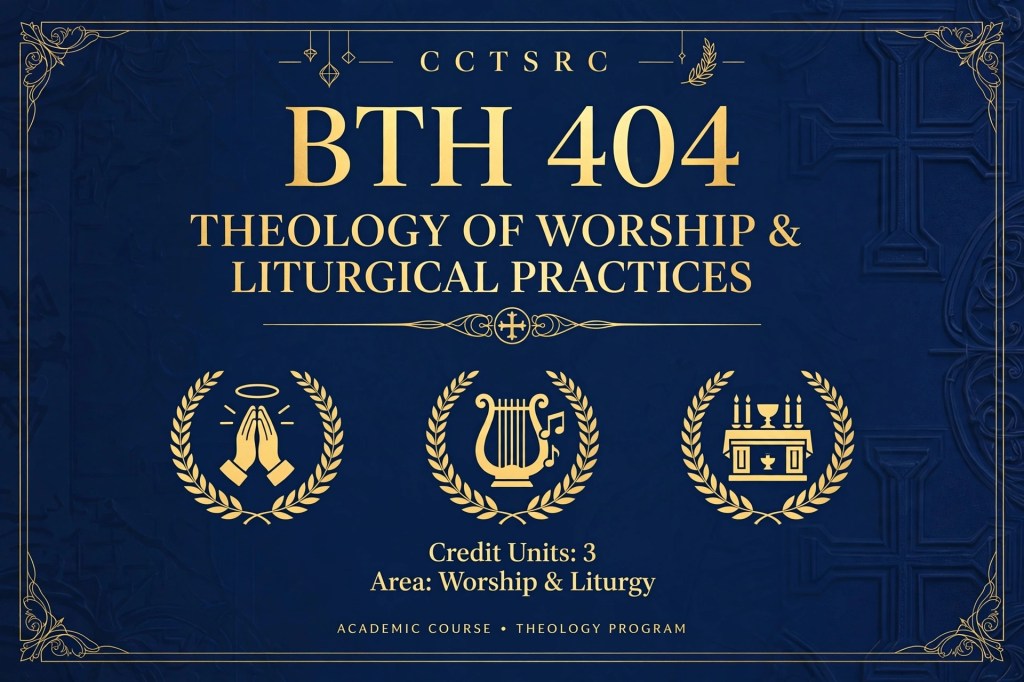
Institution: CCTSRC (Bachelor of Theology Program)
Level: Year Two, Second Semester
Credit Units: 3 Units
Area of Specialization: Worship & Liturgy
COURSE DESCRIPTION
This course explores the biblical, historical, and theological foundations of Christian worship. It equips students with the knowledge and practical skills necessary to design, lead, and facilitate corporate worship gatherings that are both theologically sound and culturally relevant. The course bridges the gap between the “heart” of worship (spirituality) and the “order” of worship (liturgy), ensuring that ministry leaders can guide congregations in rightly responding to God.
COURSE OBJECTIVES
By the end of this course, students will be able to:
- Articulate a comprehensive biblical theology of worship from both Old and New Testaments.
- Trace the historical development of Christian liturgy from the early church to modern times.
- Identify and explain the core elements of corporate worship (Word, Sacraments, Prayer, Giving).
- Understand the theological and practical role of music and the worship leader.
- Design and lead a balanced, missional worship service that honors God and edifies the church.
COURSE OUTLINE
MODULE 1: Defining Worship – The Biblical and Theological Foundations
Focus: Understanding the nature of worship as a lifestyle and a corporate act.
- Key Concepts:
- Hebrew Roots: Shachah (to bow down), Barak (to bless), Halal (to praise/boast), Yadah (to extend the hand in praise), Zamar (to make music).
- Greek Roots: Proskuneo (to kiss the hand, to bow down in reverence), Latreuo (to serve), Sebomai (to revere).
- Worship as a Lifestyle: Romans 12:1-2 establishes that our bodies are living sacrifices. Worship is not just what happens on Sunday; it is the entirety of the believer’s life.
- The Object of Worship: True worship is always directed toward the Triune God—Father, Son, and Holy Spirit.
- Lecture Notes: True Christian worship is a response to God’s revelation. We love because He first loved us. We must distinguish between “praise” (expressing gratitude for God’s acts) and “worship” (adoring God for who He is in His essence).
- Practical Application: Students must write a personal definition of worship and journal their daily acts of worship for one week.
- Review Questions: How does the New Testament redefine the physical location of worship (John 4:21-24)?
MODULE 2: Worship in the Old and New Testaments
Focus: The progression from Tabernacle sacrifice to the Priesthood of all Believers.
- Key Concepts:
- Old Testament Worship: The Tabernacle and Temple as the dwelling place of God. The sacrificial system (Leviticus) as the means of approaching a holy God. The role of the Levites and priests. The Psalms as the ancient hymnal of Israel.
- New Testament Worship: Christ as the ultimate and final sacrifice. The tearing of the temple veil (Matthew 27:51), signifying direct access to God. The shift from a physical building to the Body of Christ (the Church) as the temple of the Holy Spirit (1 Corinthians 6:19).
- The Early Church Model: Acts 2:42 establishes the four pillars of early worship: Didache (Apostles’ teaching/Word), Koinonia (Fellowship/Community), Klasis tou artou (Breaking of bread/Communion), and Proseuchai (Prayers).
- Lecture Notes: We must avoid the error of “New Testament” worship being entirely formless. It is built upon the foundation of the Old Testament but fulfilled in Christ.
- Practical Application: Compare and contrast the worship practices of ancient Israel with the modern church service.
- Review Questions: What are the four pillars of the early church’s worship in Acts 2:42?
MODULE 3: The History of Christian Liturgy
Focus: How the church has historically ordered its worship.
- Key Concepts:
- Definition of Liturgy: The Greek word leitourgia means “the work of the people” or “public service.” Liturgy is the structured form of corporate worship.
- The Patristic Era: Early church liturgies (e.g., the Didache, Justin Martyr’s First Apology). Emphasizing structure, orthodoxy, and the Eucharist.
- The Reformation: Martin Luther and John Calvin sought to reform worship, stripping away unbiblical traditions while maintaining historical order. Emphasis on the preached Word and congregational singing (the Psalms).
- The Modern Era: The rise of contemporary worship, Pentecostalism, and the “seeker-sensitive” movement. The balance between ancient-future worship and modern expression.
- Lecture Notes: Every church has a liturgy, even if they don’t call it that. A “liturgy” is simply the order of service. The question is not if we have a liturgy, but whether our liturgy is theologically sound.
- Practical Application: Analyze the historical shift from highly structured liturgical services to contemporary charismatic services.
- Review Questions: How did the Protestant Reformation change the focus of the Sunday gathering?
MODULE 4: The Core Elements of Corporate Worship
Focus: The essential components that must be present in a worship service.
- Key Concepts:
- The Word: The reading and preaching of Scripture. The sermon is not merely a lecture but an act of worship where God speaks to His people.
- The Sacraments:
- Baptism: The initiatory rite of the New Covenant.
- Holy Communion (The Eucharist/Lord’s Supper): The ongoing rite of remembrance, proclamation, and spiritual nourishment.
- Prayer: Adoration, Confession, Thanksgiving, and Supplication (ACTS). The pastor leads the congregation in corporate prayer.
- Giving: The offering as an act of worship, stewardship, and gratitude, not just fundraising.
- Lecture Notes: A service lacking Word or Sacrament is deficient. The Word and Sacrament are the “Twin Rails” of the Christian life.
- Practical Application: Create a detailed order of service for a Sunday gathering that explicitly highlights where each of the four core elements is practiced.
- Review Questions: Explain the difference between a sermon in the service versus a sermon as the service.
MODULE 5: The Theology of Music and the Worship Leader
Focus: The role of music, song selection, and the spiritual responsibility of the worship leader.
- Key Concepts:
- The Power of Music: Music bypasses the intellect and connects directly to the emotions and spirit. It aids in memorization of doctrine and unifies the congregation.
- The Role of the Worship Leader:
- A Theologian: Must ensure the lyrics are biblically accurate.
- A Pastor: Must shepherd the congregation and congregation’s musicians.
- A Facilitator: Pointing the congregation to God, not to themselves.
- Song Selection: Balancing “fast” songs (praise) and “slow” songs (worship). Balancing new contemporary songs with ancient hymns. Ensuring theologically rich lyrics over shallow, repetitive choruses.
- Lecture Notes: The music ministry is a spiritual battleground. Worship leaders must guard against pride, platform-building, and emotionalism. They must be filled with the Spirit to lead the church effectively.
- Practical Application: Choose 3 modern worship songs and conduct a theological critique of their lyrics. Identify any weak or unbiblical theology.
- Review Questions: What are the three primary roles of a worship leader?
MODULE 6: The Liturgical Calendar and Sacred Time
Focus: The rhythms of the Christian year and how to utilize them in worship planning.
- Key Concepts:
- The Concept of Sacred Time: God created time and established rhythms (Genesis 1:14). The Christian calendar helps believers re-enact the story of redemption annually.
- The Major Seasons:
- Advent/Christmas: Anticipation and celebration of the Incarnation.
- Lent/Easter: Repentance, the Cross, and the Resurrection.
- Pentecost: The birth of the Church and the Holy Spirit.
- Ordinary Time: The weeks between major seasons, focusing on the life, teachings, and ministry of Jesus.
- Benefits: Connects the local church to the global and historical church. Prevents worship from becoming solely event-driven.
- Lecture Notes: While not all churches are required to follow the liturgical calendar, it is a valuable tool for discipleship. It forces the church to focus on all aspects of the Gospel, not just our favorite themes.
- Practical Application: Develop a 4-week worship plan for the season of Advent.
- Review Questions: How does the liturgical calendar help prevent spiritual stagnation in a congregation?
MODULE 7: Sacred Space and the Environment of Worship
Focus: How architecture, aesthetics, and the physical environment impact the worship experience.
- Key Concepts:
- Sacred vs. Secular Space: Are church buildings holy? In the NT, the people are holy, but the space we gather in should be set apart for the purpose of worship.
- Architecture: How building design (e.g., high ceilings, stained glass, cross placement) directs the congregation’s focus. Traditional vs. modern designs.
- The Altar and the Pulpit: Understanding the historical significance of the pulpit (God’s Word) and the altar (prayer/sacrifice).
- Sensory Worship: The use of light, sound, visuals, and physical elements (banners, candles) to engage the senses and create an atmosphere of reverence and awe.
- Practical Considerations: Accessibility, seating arrangement (pews vs. chairs in a circle), and sound acoustics.
- Lecture Notes: The physical environment preaches a sermon before the pastor even speaks. Cluttered, unkempt spaces communicate a lack of reverence for God, while thoughtful design points to His majesty.
- Practical Application: Take a photo or draw the layout of your current church sanctuary. Analyze what message the layout communicates to a first-time visitor.
- Review Questions: How can a church use physical space to facilitate both reverence and community?
MODULE 8: Designing Missional Worship Gatherings
Focus: Creating services that are not only for the believer but also for the seeker, without compromising theological integrity.
- Key Concepts:
- The Seeker-Sensitive Movement: Historical context, its strengths (evangelism), and weaknesses (entertainment-driven, shallow theology).
- Missional Worship: Crafting services that are culturally relevant without being theologically liberal.
- The “Fourth Wall”: How to break down the barrier between the congregation and the community. Addressing issues relevant to the city/society.
- The Liturgy of the Ordinary: Equipping people to carry their Sunday worship into Monday’s workplace.
- Addressing the Unchurched: Explaining the elements of the service (e.g., “Why do we take communion?”) in a welcoming but non-condescending way.
- Lecture Notes: The church gathers to worship and scatters to witness. The Sunday gathering should be the training ground for the Monday mission.
- Practical Application: Create a “Visitor Guide” that explains the parts of your church service to someone who has never been to church before.
- Review Questions: What is the difference between a “seeker-driven” service and a “missional” service?
MODULE 9: Leading Worship – Practical Practicum
Focus: Hands-on skills for planning, rehearsing, and executing a worship service.
- Key Concepts:
- The Planning Process: Selecting themes, Scripture readings, sermon alignment, and song selection. The use of Planning Center or similar software.
- Rehearsals: Working with musicians, managing time, and ensuring musical excellence without sacrificing spiritual focus.
- Flow and Transitions: How to move seamlessly from song to prayer, or from the sermon to the benediction. The use of spoken liturgy.
- Handling Distractions: Technical difficulties, crying babies, unexpected interruptions. Maintaining composure and focusing on God.
- The Benediction: Sending the congregation out with a blessing and a commission. It is not just a dismissal; it is a sending.
- Lecture Notes: Leading worship is a form of spiritual warfare. The leader must be fully present, fully prepared, and fully reliant on the Holy Spirit.
- Practical Application: Students must develop a comprehensive Order of Service for a hypothetical Sunday, detailing every transition, song, prayer, and reading.
- Review Questions: What are the most critical steps in preparing for a Sunday service?
RECOMMENDED TEXTS
- Primary Text: Worship by the Book by D.A. Carson (ed.)
- Secondary Text: The Worship Architect: A Blueprint for Designing Culturally Relevant and Biblically Faithful Services by Constance M. Cherry
- Supplementary: Engaging with God: A Biblical Theology of Worship by David Peterson
- Historical: Ancient-Future Worship: Proclaiming and Enacting God’s Narrative by Robert E. Webber
COURSE REQUIREMENTS & ASSESSMENT
- Attendance & Participation (10%): Active engagement in lectures and discussion.
- Weekly Reflection Papers (20%): Short essays (500 words) on the module topics.
- Practical Assignment (30%): Designing a complete worship service (including a detailed script, song choices, and a theological rationale for each element).
- Final Exam (40%): A comprehensive written examination covering all 9 modules.
NB:
“Be diligent to present yourself approved to God, a worker who does not need to be ashamed, rightly dividing the word of truth.”
(2 Timothy 2:15 NKJV)


Leave a Reply