COURSE HANDOUT
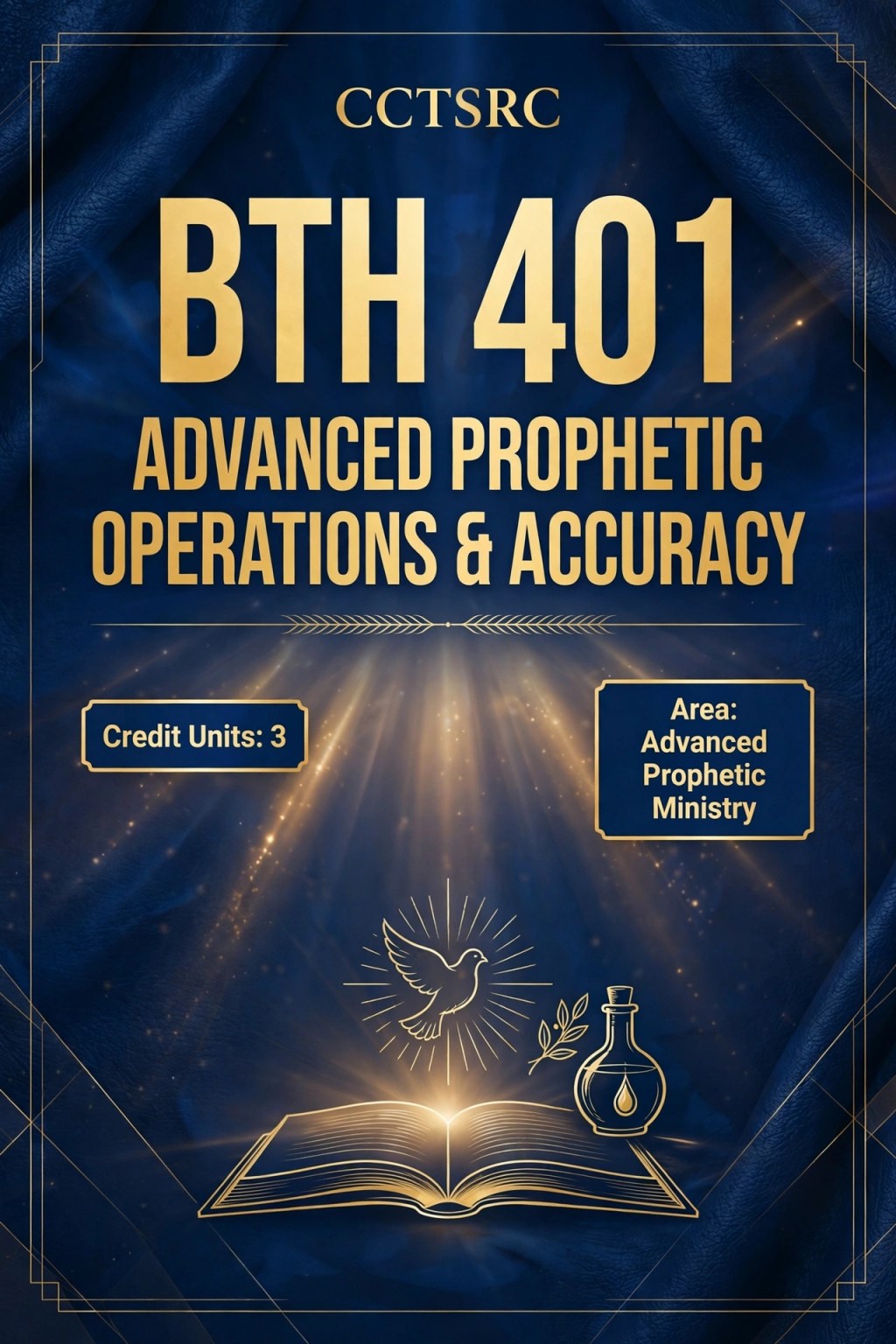
COURSE CODE: BTH 401
COURSE TITLE: Advanced Prophetic Operations & Accuracy
CREDIT UNITS: 3
LEVEL: Year Two – Second Semester
AREA OF SPECIALIZATION: Advanced Prophetic Ministry
COURSE DESCRIPTION
This advanced course is designed to equip students with a deep, biblical, and practical understanding of prophetic ministry. Moving beyond the elementary principles of prophecy, this course explores the mechanics of prophetic operation, the character required to sustain the prophetic anointing, the intersection of revelation and interpretation, and the critical need for accuracy and accountability. Students will learn to navigate the complexities of prophetic ministry within the local church, engage in prophetic intercession, and avoid the common pitfalls of manipulation, false prophecy, and spiritual pride.
COURSE OBJECTIVES
By the end of this course, students will be able to:
- Articulate a robust biblical theology of prophecy from both Old and New Testaments.
- Identify and distinguish between the voice of God, the human spirit, and demonic influence.
- Develop protocols for judging, testing, and weighing prophetic revelation.
- Understand the ethical responsibilities and accountability structures for prophetic ministers.
- Integrate prophetic ministry healthily within the local church and pastoral leadership.
- Demonstrate practical proficiency in prophetic activation and delivery.
COURSE MODULES
MODULE 1: Biblical Foundations of Prophecy
1.1 Defining the Prophetic
The term “prophet” (Hebrew: Nabi; Greek: Prophetes) fundamentally means one who speaks forth or acts as a spokesperson for another. A prophet is God’s mouthpiece, receiving divine revelation and communicating it to a specific audience. Prophecy in scripture is not primarily about predicting the future (foretelling); it is primarily about speaking God’s heart and mind into a present situation (forthtelling).
1.2 The Old Testament Prophetic Model
- The Nature of OT Prophecy: The OT prophets operated as covenant enforcers. They called Israel back to faithfulness to Yahweh and the Mosaic covenant. They spoke to kings, priests, and the nation.
- The Prophetic Schools: We see the emergence of prophetic guilds or schools (e.g., under Samuel, Elijah, and Elisha in 1 Samuel 19:20, 2 Kings 2:3). This indicates that prophetic ministry involved mentorship, training, and community.
- Case Study: Examine the transition of Elijah to Elisha (1 Kings 19, 2 Kings 2). Note the elements of succession, the double portion anointing, and the testing of the prophetic mantle.
1.3 The New Testament Prophetic Model
- Jesus as the Ultimate Prophet: Jesus is the Logos—the perfect revelation of God (Hebrews 1:1-2). He operated in the Spirit of prophecy without measure (John 3:34).
- The Day of Pentecost: Acts 2 marks a paradigm shift. Joel 2:28-29 is fulfilled: the Spirit is poured out on all flesh—sons, daughters, young men, old men, servants. Prophecy becomes a corporate and inclusive reality within the Body of Christ.
- The Function in the Early Church: Prophets were foundational to the church (Ephesians 2:20). They provided direction (Acts 13:1-2), encouragement, and edification (1 Corinthians 14:3).
1.4 Distinguishing the Prophetic from Preaching
While preaching (teaching) is the exposition of the already-written Word, prophecy is the spontaneous, inspired utterance of the Rhema Word for a specific moment. Preaching tells you what God has said; prophecy often tells you how God is applying it right now.
- Discussion Questions: How does the New Testament democratization of prophecy affect how we view modern prophetic ministry? What are the dangers of elevating the “prophet” over the “Word”?
MODULE 2: The Prophetic Call and Character
2.1 The Prophetic Calling
The prophetic call is divine and sovereign. It is not a career choice but a supernatural interruption (e.g., Jeremiah 1:4-10, Isaiah 6:1-8, Amos 7:14-15). The call often involves:
- Divine Confrontation: An encounter with the holiness of God.
- Cleansing/Preparation: Isaiah’s lips touched with a live coal.
- Commissioning: Sending the prophet with a specific message.
2.2 The Crucible of Preparation
God uses time, obscurity, and testing to prepare His prophets. David was a shepherd before he was a king; Moses spent 40 years in the wilderness; Joseph was in prison. The wilderness is where the prophet’s character is forged, and his reliance on God is established. A prophet cannot simply be talented; he must be broken.
2.3 Character: The Container of the Anointing
The anointing is what God gives; the character is what we bring. Without godly character, the anointing will eventually destroy the vessel.
- Humility: The prophet must realize he is a steward of revelation, not the author of it.
- Integrity: The private life of the prophet must align with his public message.
- Brokenness: Prophets must have a heart that breaks for what breaks God’s heart.
- The Balaam Spirit: Balaam had accurate prophecy but a compromised heart. He sought to manipulate God for financial gain (2 Peter 2:15, Jude 1:11). Prophets must guard against the love of money and the desire for personal gain.
2.4 The Pitfalls of Prophetic Pride
The greatest danger to a mature prophet is spiritual pride. When God uses you to reveal secrets, speak to nations, or predict futures, there is an immense temptation to feel superior to others. Prophets must remain accountable to community and mentorship.
- Assignment: Research the life of a biblical prophet who failed in character (e.g., Samson, Jonah, Balaam) and write a 500-word analysis of the consequences of their character flaws on their prophetic mandate.
MODULE 3: Hearing the Voice of God
3.1 The Prerequisite of Relationship
Before you can hear God’s voice, you must know His heart. Prophets are not fortune-tellers; they are friends of God (John 15:15). Revelation flows out of intimacy. The secret of the Lord is with those who fear Him (Psalm 25:14).
3.2 The Anatomy of Revelation
God speaks through a variety of means. The New Testament minister must be attuned to the Spirit’s frequency.
- The Inward Witness: A deep, abiding knowing in the spirit (Romans 8:16).
- The Still Small Voice: A gentle impression that requires stillness to hear (1 Kings 19:12).
- The Inner Audible Voice: Hearing God speak in your mind.
- Vision: Seeing with the eyes of the heart (Ephesians 1:18). Can be an open vision (seeing into the spirit realm) or a mental vision (a picture/imagination).
- The Written Word: The Bible is the ultimate filter for all revelation. God will never contradict His written Word.
3.3 Distinguishing the Voices
There are three primary sources of revelation that every prophet must learn to separate:
- The Holy Spirit (The Voice of God): Always aligns with Scripture, brings peace, and exalts Christ. It edifies, exhorts, and comforts.
- The Human Spirit (Flesh/Soul): Our own desires, fears, traumas, and biases. This is why the prophet must be emotionally healed and self-aware. A wounded soul projects its wounds onto others.
- The Demonic/World System: Satan can counterfeit revelation. He can speak to the mind (temptation). He can even quote scripture (Matthew 4). We test the spirits because not every spirit is from God (1 John 4:1).
3.4 The Grid for Discernment
To hear accurately, one must develop a “Grid”:
- The Scriptural Grid: Does it violate the Bible?
- The Character Grid: Does it produce the fruit of the Spirit or the works of the flesh?
- The Peace Grid: Does it leave a sense of confusion and anxiety, or does it bring the peace of Christ? (Colossians 3:15).
MODULE 4: The Language of the Spirit
4.1 Understanding Symbolic Communication
Prophecy is often pictorial and metaphorical. God uses symbols because they bypass the mind and speak directly to the heart. Examples include:
- Numbers: (e.g., 7 = completion, 40 = testing, 12 = governmental order).
- Colors: (e.g., White = purity/righteousness, Red = blood/salvation or sin, Gold = glory/refining).
- Elements: (e.g., Water = Spirit/Word, Fire = purification/passion, Wind = Spirit).
- Objects: (e.g., Keys = authority/access, Trees = people/nations, Doors = opportunity).
4.2 Dreams and Visions
- Types of Dreams:
- Soul Dreams: Processing the day’s events (Job 4:13).
- Warning Dreams: Giving direction or protection (Matthew 2:13).
- Prophetic Dreams: Revealing future events or God’s will (Genesis 37).
- Interpretation: The Bible is the best dictionary for symbolic interpretation. We interpret through the lens of the Spirit, not through secular dream dictionaries. A key principle in interpretation is that the context of the dreamer matters immensely.
4.3 Prophetic Gestures and Object Lessons
Sometimes God requires the prophet to act out the message. (e.g., Jeremiah wearing an ox yoke, Ezekiel lying on his side, Hosea marrying Gomer). These are called “prophetic acts” or “signs.” They are a physical manifestation of a spiritual truth. However, these must be done under strict divine command, not human theatrics.
4.4 The Art of Interpretation
Interpretation is not a formula; it is a partnership with the Holy Spirit.
- The Principle of Audience: Who is the message for? The individual, the church, or the nation?
- The Principle of Time: Is this for now, or a future season?
- The Principle of Proportion: Not every picture requires a deep, mystical meaning. Sometimes a tree is just a tree.
- Practical Exercise: In class, students will be given 5 symbolic dream scenarios and asked to write down potential interpretations based on biblical typology.
MODULE 5: Prophetic Accuracy and Accountability
5.1 The Mandate for Accuracy
In the Old Testament, the penalty for a false prophet was death (Deuteronomy 18:20-22). While we are under grace, the standard for truth remains high. Prophets must be accurate. Accuracy is a product of intimacy and character. A 100% accuracy rate is the goal, but a spirit of fear is not permitted.
5.2 Testing and Weighing Prophecy
The New Testament instructs us, “Do not despise prophecies. Test all things; hold fast what is good” (1 Thessalonians 5:20-21).
- The Role of the Prophetic Community: In the Old Testament, prophets were often evaluated by other prophets. In the New Testament, the church is to judge (weigh) prophetic words (1 Corinthians 14:29).
- The Criteria for Testing:
- Does it align with the Bible?
- Does it exalt Jesus Christ? (Revelation 19:10).
- Does it produce godly fruit (edification, exhortation, comfort)?
- Does it agree with the witness of the Holy Spirit in the receiver’s heart?
5.3 Handling Mistakes and the Fear of Man
- The Spirit of Elijah vs. The Spirit of Ahab: Ahab surrounded himself with prophets who told him what he wanted to hear (1 Kings 22). The prophet of God must resist the fear of man and the temptation to people-please.
- The “Conditional” Prophecy: Many prophecies are conditional based on the response of the recipient (e.g., Jonah and Nineveh).
- How to Handle a Miss: Prophets are not infallible. When a prophecy misses, it should be handled with humility, acknowledgment, and a commitment to learn without falling into shame.
5.4 Accountability Structures
No prophet is an island. Prophets must be submitted to:
- Local Church Government: (Pastors, Elders).
- Prophetic Presbytery: (A group of seasoned prophets/prophetic people).
- Peer Accountability: (Trusted friends who can tell you when you are off).
MODULE 6: Prophetic Ministry in the Local Church
6.1 The Local Church as the Primary Context
The church is not just a place for prophetic ministry; it is the arena where the prophet is built, tested, and matured. Prophets must learn to function within the house, not on the periphery.
6.2 The Relationship Between Pastor and Prophet
- The Pastoral Heart: The pastor is the shepherd; the prophet is the mouthpiece.
- The Potential Conflict: Prophets are focused on truth and direction; pastors are focused on nurture and protection. The prophet can be seen as disruptive; the pastor can be seen as controlling.
- The Necessary Partnership: When the pastor and prophet work together, the church thrives. The prophet provides the map (vision); the pastor provides the vehicle (structure).
6.3 The Prophetic Culture
A healthy prophetic culture is established when:
- God’s voice is honored: Prophecy is expected, not feared.
- Safety is prioritized: Prophets are trained, mentored, and corrected gently.
- Every member is activated: The spirit of prophecy is not just for the “prophet” but for the whole church (Acts 2:17).
6.4 The Prophetic Presbytery
We see the presbytery in 1 Timothy 4:14. This is a group of elders/prophets who lay hands on individuals to impart gifts, confirm callings, and release spiritual authority. This model protects individuals from acting on a solitary, unconfirmed word.
- Case Study: Examine the situation in the church at Corinth (1 Corinthians 14). Paul had to correct the chaotic use of prophecy. The answer was not to cease prophecy, but to do all things decently and in order.
MODULE 7: Prophetic Intercession and Warfare
7.1 The Intercessory Prophet
Intercession is standing in the gap between God and man (Ezekiel 22:30). The prophetic intercessor sees what God sees, feels what God feels, and prays the mind of God into the earth. The prophet is often a “watchman on the wall” (Isaiah 62:6).
7.2 Prophetic Prayer
When the prophet prays, he/she prays from the realm of revelation. They do not just pray for circumstances; they pray the decrees and purposes of God. “Thy kingdom come, thy will be done, on earth as it is in heaven” (Matthew 6:10). This involves decreeing and declaring the Word of the Lord.
7.3 Spiritual Warfare and the Prophet
The prophet is a target of the enemy. Because the prophet brings revelation, the enemy seeks to silence, distract, or destroy them. Prophets must learn to:
- Put on the Whole Armor of God (Ephesians 6:10-18).
- Identify the strongholds in their city, region, and nation.
- Engage in Praise and Worship Warfare (2 Chronicles 20:21-22).
7.4 The Watchman Anointing
A watchman sees the sword coming and blows the trumpet (Ezekiel 33:1-9). This is a heavy burden. The prophet must remain awake and alert, not just for his own soul, but for the souls of the congregation. If the watchman fails to warn, the blood is on his hands. This highlights the immense responsibility of the prophetic office.
MODULE 8: Ethics and Pitfalls in Prophetic Ministry
8.1 The Abuse of Authority
The prophetic office carries spiritual weight. A prophet can easily manipulate or control others by claiming, “Thus saith the Lord.”
- The Rule: True prophecy never violates human free will. God gives us choices; He does not force us to follow Him.
- The Warning: Beware of using the prophetic to build a personal empire or to demand unquestioning loyalty to oneself.
8.2 Financial Manipulation
A major pitfall is turning prophecy into a business. “Prophet for profit” is an ancient trap (Micah 3:11, Titus 1:11). Prophets must never allow their financial needs to dictate what they prophesy. The ministry of the prophet must be free from the love of money.
8.3 Sexual and Emotional Entanglement
The enemy often targets the prophet through sexual sin, emotional dependency, or inappropriate relationships. Because prophets are deeply empathetic and feel things intensely, they are vulnerable to crossing boundaries. Prophets must maintain strict, healthy boundaries, particularly when counseling or praying for the opposite sex.
8.4 The Spirit of Divination and the Occult
There is a counterfeit to the prophetic. The world is full of psychics, mediums, and astrologers. The church must be vigilant to distinguish between the Holy Spirit and the spirit of divination (Acts 16:16-18). The difference lies in the source (God vs. demons) and the fruit (edification vs. bondage).
8.5 Navigating Popularity and Rejection
Prophets will experience extreme highs (being celebrated, invited to speak) and extreme lows (being rejected for speaking the truth). They must find their identity solely in Christ, not in the applause of the crowd or the opinions of man.
MODULE 9: Practical Practicum
9.1 Prophetic Activation
Students will engage in guided activation exercises. This involves:
- Praying in the Spirit: Tuning the heart to the frequency of heaven.
- Asking God for a Word: Learning to receive a specific word for a specific person.
- Delivering the Word: Practicing the “sandwich method” (Encouragement – The Prophetic Word – Encouragement). Learning to deliver truth with love and grace.
9.2 Prophetic Etiquette in Corporate Settings
- How to interrupt a service: When is it appropriate to speak out, and when should a word be submitted to the leadership first?
- Microphones and Volume: Being respectful of the flow of the service.
- The “Stop” Signal: Learning to discern when the Holy Spirit is finished with a word or when to yield the floor.
9.3 Peer Review and Feedback
Students will form groups and practice delivering words to one another. They will be graded on:
- Biblical Alignment: Is the word scripturally sound?
- Tone and Delivery: Was it delivered with humility and love?
- Relevance: Did it speak to the actual person?
9.4 Building a Personal Prophetic Ministry Plan
Each student will develop a plan for their ongoing growth, including:
- A system for record-keeping (journaling dreams, visions, words).
- A plan for mentorship (finding a spiritual father/mother in the faith).
- A commitment to accountability (a safe group to share prophetic insights).
COURSE ASSESSMENT
- Class Attendance and Participation: 10%
- Prophetic Journal: (Record 10 dreams/visions/words and their interpretations/outcomes over the semester): 20%
- Book Review: (Read a selected biography of a prophetic figure or a classic work on the prophetic): 20%
- Practical Prophetic Practicum: (In-class activation and delivery evaluated by peers and the instructor): 20%
- Final Research Paper: (A 3,000-word theological paper on a topic related to prophetic accuracy or accountability): 30%
RECOMMENDED READING
- The Prophetic Ministry by Rick Joyner
- Developing Your Prophetic Gifting by Graham Cooke
- Prophetic Etiquette by Mike Bickle
- The Seer by James W. Goll
- Basic Training for the Prophetic Ministry by Kris Vallotton
- Let the Prophets Speak by R. Loren Sandford



Leave a Reply